Saturday, 28 December 2013

Retro Ride

My mind wanders during car journeys. On a recent drive to visit family in the north of Scotland I
Old faithful
imagined what would it be like to hop back aboard the steel-framed Peugeot that was my teenage years’ pride and joy? Would the current, approaching-forty me cope without his lightweight, carbon-fibre steed; would my ageing legs cope without a compact?

There was only one way to find out, so I clambered into the dustiest corner of my mother’s garage and returned dragging a relic. It needed new tyres, a pair of pedals would be useful, but otherwise it looked perfectly serviceable.

I don’t always appreciate just how advanced my current ride is in comparison to that early-Nineties, utterly basic bike. It’s also true to say that the teenage me failed to appreciate how lucky he was to reside in such great cycling country. I grew up in Fochabers, a village near the Moray coast and on the edge of Highland Speyside. My extended backyard was packed with quiet roads, cracking climbs and the kind of scenery tourists travel thousands of miles to gaze at.

So it was at Fochabers that this nostalgic experiment would begin and end. I’d opted for one of the aces from my riding repertoire — a 60-mile loop around Malt Whisky country with almost 4000 feet of ascent.

Friday, 13 December 2013

Not Just For Christmas

PERFECT FOR ANYONE — EVEN WEIRDOES

The Breakaway would make the perfect gift for any cyclist  — especially those who can read —  and non-cyclists (weirdoes that they are) would love it too.

Well I would say that, wouldn’t I?

Yes, I would, but it happens to be true. There is a lot of cycling in The Breakaway, and a lot of cycling up mountains (roughly equivalent to three ascents of Everest). There’s also a lot of humour — laughter inspired by heatstroke, oxygen debt and the likes of The Goonies, bicycle-eating Italian goats, Marmot smuggling, Goose from Top Gun, Minxy the mutant Playmate, and more.

Life’s not all giggles and energy jells though, and neither is The Breakaway. There are some serious issues in there too, such as my struggle to overcome grief whilst attempting to overcome hors category mountain passes, and dealing with a friendship that was balanced on a rocky precipice like the bus at the end of The Italian Job.

HOW TO SEND AN E-BOOK AS A GIFT

“Okay, I’m sold”, I hear you cry, “but how to gift the cyclist/reader in my life an e-book?”

Simple. If you're in the UK the easiest way is to send a gift card by email. Make it out for the amount of the book you wish to gift (mine, at £3.99, of course), add the lucky recipient's email address and then type a suitable message in the box before you click buy – something like: “The Breakaway – Cycling The Mountains of the Tour France sounds like it's right up your allez.”

And don't forget to include a link to the book of your choice – there's one for The Breakaway here:
http://www.amazon.co.uk/The-Breakaway-Cycling-Mountains-France-ebook/dp/B00BO9LLG8

If you're in America and using Amazon.com then it’s even easier — just find the book you want to gift and click the Give as a Gift button (you Yanks don't know how easy you've got it!).

WHAT ABOUT ME?!

What if you don’t know a cyclist/person who can read? Then gift a copy to yourself, of course (and make finding some cyclist/more intelligent friends your top new year’s resolution).

You don’t even need  to own a Kindle. Download the Kindle reader app and you can Breakaway on a desktop, laptop, tablet, smartphone, and maybe even a teapot (or perhaps not).

You’ve had a tough year, you’ve been a very good boy/girl/hermaphrodite — you deserve a copy of The Breakaway.

But remember, this book is not just for Christmas. If you’re a slow reader it might well last through to the end of the Ardennes Classics.

Saturday, 7 December 2013

Dinner On The Pass

Cycling and food are two of passions of mine. Sometimes I wonder if the main reason for the former is to create a calorie deficit that excuses my intake of the latter.

View from the hot seat
I recently had the privilege of enjoying Dinner on the Pass in The Sheraton hotel's One Square kitchen. The cycling equivalent of this foodie experience would be to ride in a pro-team car that's driving  alongside the peloton: sitting at the pass, watching the kitchen work at full steam; the brigade of chefs in perfect synchronisation, gathered around their leader, selflessly doing his bidding, preparing the ground for a team's grand victory (and at the feed zone the musettes held more promise than energy gels and rice cakes).

The road book
In this peloton, Sheraton Executive Chef, Malcolm Webster, is patron, running his kitchen in a manner that's surprisingly calm yet clearly effective: beware fans of the swearing and sweating kitchen cliché, you might be disappointed.

In fact, my previous experience of a hotel kitchen was a stint, many moons ago, as a kitchen porter in Edinburgh’s George Hotel – an experience of grovelling, sweating, anger-filled heat that put me off catering-as-profession for good. The experience was something on the same grovelling, gruesome level as Orwell’s Down and Out in Paris and London. Suffice to say the plungeur's life was not for me.

Prolougue
Chef Webster's kitchen is the antithesis of that, a place that employs the cooking equivalent of Team Sky's
marginal gains philosophy. There's no naked gas flame here, only inductive stoves and hobs (not to mention the Green Egg barbecue, the steamers and sous vide machines). Huge ceiling fans and ducts suck out the heat and pump in cool, calming air. Orders come through on a printer and each section gets a copy so the atmosphere is quiet, minus the barked call-and-answer routine we've all seen done to death on Masterchef — why do things they way they have always been done when there's a better, modern method? Whisper it: yes chef.

A fast stage
The queen stage
So as I sat at the shining marble-slab of a pass, feeling like a cross between Greg Wallace and Mr Creosote, Chef Webster dished up a six-course menu that was perfectly balanced, like the route of week-long stage race.


We began with a prologue of beetroot and Connage crowdie, and then sprinted towards the coast and an oceanic Partan bree. A well-judged intermediate stage of barbecued mackerel led back inland to the Queen stage of turbot with oxtail (a dish I will dream about for years to come). The leader’s jersey was challenged by a serving St Bride’s Farm duck, before the short but satisfying penultimate étape of Smoked Cuddy’s Cave cheese and quince.

The dénouement was a final flourish dessert called Pudding on the Pass, like laps of the Champs Elysees, had Salvador Dali been the original Paris city-planner (imagine using a spoon to pick your way through the remains of a sweet shop that's been dropped from a great height, and you’re only halfway to getting it).

Yellow-jersey challenger
Chef Dali adds a flourish
Chef Webster not only dished up amazing food, he didn't seem to mind my constant interruptions and enquiries. He was asked about everything from poaching eggs (they gently steam theirs in the shell before cracking them into water to maintain that perfect shape) to his opinions on Professional Masterchef, and answered with a the kind of passion and knowledge that was evident in his kitchen's end product.

By the time we stumbled out into the night, I was grinning inanely and doing my best to keep thoughts from the coming day's calorie-crunching bike ride.

Monday, 29 July 2013

High-Mountain Heroes

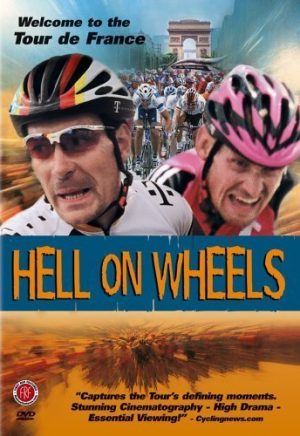
Erik & Rolf in hell
In 2004 I went to the cinema in Edinburgh to watch Hell on Wheels (Hollentour, in its native German). The movie is a documentary by French director Pepe Danquart's and tells the story of the 2003 Tour de France through the eyes of the T-Mobile team and two of their riders, sprinter Erik Zabel and his faithful domestique, Rolf Aldag.

I enjoyed the film, liked seeing cycling and the Tour on the big screen. I enjoyed little insights such as the fraternal relationship between team leader and domestique.

However much I enjoyed it though, I left the cinema feeling none the wiser (perhaps less the wiser). I wanted to know, to really know, what it took to ride the Tour, what was going on behind the curtain, or at the back of the bus. I liked seeing how Zabel's soigneur lathered the cream onto his rider's chamois, but what about the real secrets to the sprinter's success? What were the riders swallowing and injecting when the cameras weren't rolling. And if the riders on the screen weren't swallowing and injecting, then what did they think of their team-mates who were?

Ten years on and Zabel has finally offered a glimpse behind the curtain, given in to the inevitable pressure for truth and admitted to the use of EPO, cortisone and blood doping. Yes he suffered in the heat and on the climbs - him and all the rest - but he also re-transfused his own blood. That's the stuff I wanted to know about back in 2004, the stuff we all suspected but weren't about to be shown, especially not in Technicolour on the silver screen. (Had Pepe Danquart shown us the blood coming out and going back in then it really would have seemed like a glimpse into cycling hell.)

By the time I hit the mountains of Europe to ride The Breakaway I was already pretty disillusioned with pro-cycling. My desire to see behind the curtain had reached insatiable levels; I no longer believed in what I saw on the TV screen, what I read about in the monthly magazines. So it was away from the men who raced the bikes and to the mountains themselves that my admiration and awe were directed  (and, to a lesser degree, to myself, because I was riding climb after climb on nothing but bread and water - or, in my case, SIS Electrolyte energy drink, a whole load of dried apricots and apricot-jam-filled croissants).

I really hope the pro-peloton's current proclamations of a new era really are to be believed (this time, finally) but, to be honest, I don't care. My cycling heroes reach high into the clouds, their reputations incontrovertibly rock-solid. Names like Ventoux, Tourmalet and Izoard will never test positive, never let me down.

Thursday, 25 July 2013

Remembering Marco

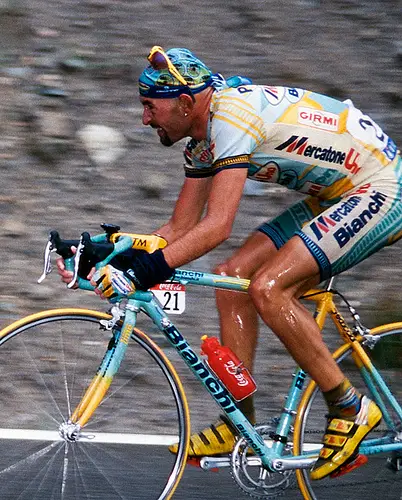
pic from cycling-passion.com
The late Marco Pantani was a cyclist I greatly admired, a climber whose exploits further fuelled my admiration of the cycling climber and stoked my ambition to go to Europe and try the mountains for myself. He was also the cycling inspiration of Drew, my companion during the travels that make up my book, The Breakaway - Cycling the Mountains of the Tour de France. Without Marco I might never have ridden Alpe d’Huez, the Stelvio, Mont Ventoux, et al.

Pantani was oft compared to an artist; Lance Armstrong called him the Salvador Dali of cycling. He rode with unbridled panache, making crazy decisions to attack based on gut feeling, eschewing modern training and racing aids such as the heart-rate monitor.

However, as the French Senate confirmed on Wednesday Pantani also doped, in this case with EPO, during the 1998 edition of the Tour de France, which he won. Pantani wasn’t alone in his indiscretions: second-placed rider that year, Jan Ulrich, also retroactively tested positive for EPO, as did the American, Bobby Julich, who finished third. It was just those three, and all the rest – the ’98 Tour will forever be synonymous with the Festina affair. Watchmaker Festina was the title sponsor of the team whose soigneur was caught with performance enhancing drugs prior to the race start. The arrest lifted the lid on the sport’s pharmaceutical underbelly and triggered the greatest scandal cycling would see for, well, until the next scandal.

Tuesday, 23 July 2013

Lightning Quick

The thunder and lightning currently blasting my neighbourhood of Edinburgh into submission is pretty scary, but none will ever be as scary (I hope!) as that which nearly welded me onto the tarmac of the Col d'Aubisque:

Whilst I clung onto Drew’s back wheel and chuckled at what I saw as an irrational fear, the lightning caught up and cracked directly overhead. That explosion of noise was the loudest thing I have ever heard, hopefully the loudest thing I will ever hear. The air turned bright blue as its water content sizzled to the boil. The hairs on our necks stood on end as if we’d stuck our fingers into a electric socket; those power lines I had so recently joked about hissed, buzzed and visibly jerked on their pylon mounts like a sack full of body-popping snakes — the danger I had dismissed suddenly all too real. I shifted up a gear and raced passed Drew, no longer as brave nor as forthcoming with suggestions as to what the lightning might do next. It was all too bloody obvious: we were about to be cooked alive!

To read more click here and pick up a copy of The Breakaway for just £3.99/$4.99.

Friday, 19 July 2013

Best of Times, Worst of Times

One of the great things about having ridden a load of Tour climbs is pretending to know how the peloton feels as the Tour cruises and crawls over the same roads. Stage 19 takes in the Col du Glandon and the Col de la Madeliene, both of which I tackled during The Breakaway. For me the Madeleine was a total and utter nightmare. I suffered like a dog (trapped inside a hot car) the whole way up. The Glandon was that day's second ascent and, surprisingly, I recovered enough to find it, dare I say, enjoyable.
Click to enlarge profile

Who knows how the pros will be feeling as they roll off one Col and on to the next (sore, I'd expect, what with two and a half weeks of racing and yesterday's Alpe D double in their legs). Hopefully more like I felt on the Glandon and not as bad as I felt on the Madeleine.

The worst of times upon the Madeleine:

Cooked atop Madeleine
I was battling with every available ounce of willpower but truly going nowhere; even butterflies were overtaking me. Drew, on the other hand, was feeling (at least relatively) great and refusing to hold anything in reserve for the Glandon. He was also refusing to wait for me, cruised off up the climb and was soon a distant blue dot upon my far horizon — surely a revenge of sorts for my dismissive attitude on La Plagne the previous day. I at once hated and admired my friend, jealousy at his strength countered only by wonder. I felt utterly pathetic as he danced delicately on the pedals, pulling the tarmac down and beneath his tyres. The sun that had become my bête noire was his best friend. Sleeves rolled up and smiling, to him the Madeleine was nothing more than an opportunity to top up the tan whilst taking in a bit of a hill. And with each glimpse of his prowess, the circling vultures of negativity closed in.

A couple of particularly steep corners later and I was audibly cursing Drew, spitting my disdain as if his contrasting condition and velocity were all at my expense. He was purposely taunting me, riding me into the ground as revenge for my actions upon the Stelvio, for having ignored his concerns on the Izoard and La Plagne, for having forced him to come on this trip with its evil Folder of Doom. Was he really so stupid, really so spiteful? I would have spat in disgust had my saliva not already dried up and disappeared.

The best of times upon the Glandon:

The air cooled considerably the higher we climbed, an arrestingly fresh mountain atmosphere that proved a stark contrast to the day's earlier, stifling extremes. Whereas on the Madeleine it had felt like I'd been inhaling hot sand, this new breeze was like an elixir, each intake of breath verging upon a quasi-religious experience. No doubt thanks to that climatic change, the remainder of the energy I had sorely lacked that morning returned, and then some. Drew was either fatigued or had grown accustomed to the idea of my continued existence, no longer expressing the desire to be a bike-length ahead at all times. Just as well too; given half the chance I would have been down in the drops, out the saddle, doing my best Pantani impression. It was inconceivable that the climb on which I had almost thrown my bike into the valley could be part of the same day. My earlier miseries were a lifetime away, part of some distant nightmare or a horror story overheard.